
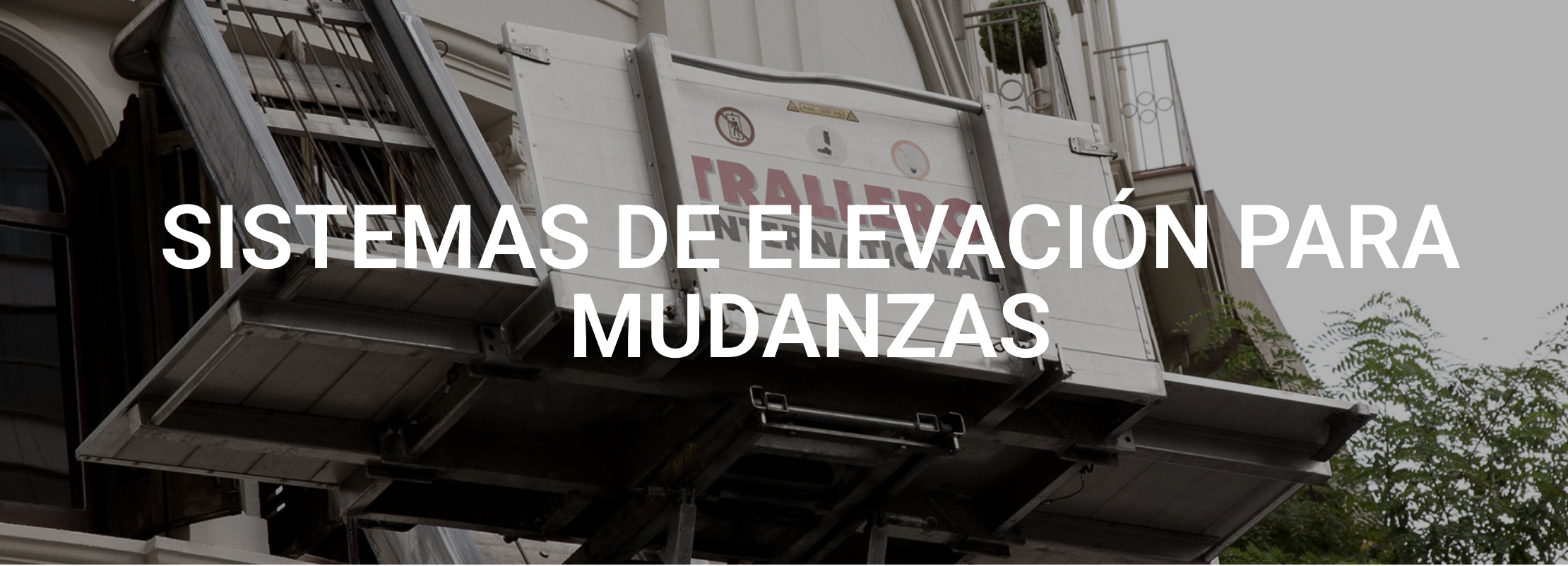
A wardrobe that won’t turn on the landing, a sofa that won’t fit in the lift, a sixth floor with no lift. Almost every question about an exterior furniture hoist for a move is born in that moment, and the ideal is to settle it before moving day, not with the furniture already on the stairs.
The good news is that the decision can be made well in advance if you look at three things: what you’re going to move, where it has to pass through and what’s in front of the facade.
What an exterior furniture hoist is
An exterior furniture hoist is a lifting platform that rests on or is set up next to the facade and raises or lowers furniture and boxes directly through a window or a balcony. This avoids the building’s stairs and lift. It shouldn’t be confused with a moving crane, which is used for very heavy pieces or heights the platform can’t reach.
Its advantage is obvious in a tall building or one with difficult access: fewer trips up and down the stairs, less risk of knocking walls and railings and less strain on the team. And the drawback? It needs space on the street and, sometimes, permits.
Three signs you’ll need one
Start with the furniture that won’t fit. If a sofa, a wardrobe or a dining table won’t go into the lift and the stairwell is narrow, moving through the facade is usually the safest option. Measure before you assume: doors, landings and the turns of the staircase.
Another clear sign is height with no lift, or with a lift so small that it only takes a couple of boxes per trip. From a third or fourth floor up, every trip counts, and in a full home we’re talking about dozens of trips.
Then there’s timing. If the building limits the hours the lift can be used or the residents’ association doesn’t want it blocked for a whole morning, taking the load out through the exterior shortens the day considerably and reduces the disturbance to neighbors.
What to check before requesting one
Look first at the window or the balcony: it needs an opening wide enough for the largest item and clear interior space to receive it. A fixed railing or a shutter that can’t be removed completely changes the picture.
Next, look at the street. The platform needs the truck or the hoist to be positioned next to the facade, and that means checking for trees, cables, terraces or bus lanes. In Barcelona and in many towns, occupying the public road for a move requires a municipal permit that is processed in advance.
Height matters too. The usual platforms cover most residential buildings, but each piece of equipment has a maximum reach, so always state the exact floor when requesting a quote.
Our view: if you’re unsure whether to use the exterior hoist or not, it’s almost always better to assess it during the pre-move survey than to improvise on moving day. A piece of furniture stuck on a landing ends up costing more than a well-planned platform.
Ask whether your move needs hoist support
At Mudanzas Trallero we check access, measurements and the facade before proposing an exterior hoist or another lifting system, so that you only use it if it genuinely saves you time or risk. If you live on a high floor, have bulky furniture or your building has difficult access, tell us when requesting a quote and we’ll tell you which option fits your case.
The more information you give us about the floor, the lift and the street, the more accurate the plan will be. The Mudanzas Trallero team will advise you on whether you need a platform, a municipal permit or simply a good loading plan. Ask whether your move needs hoist support.




