
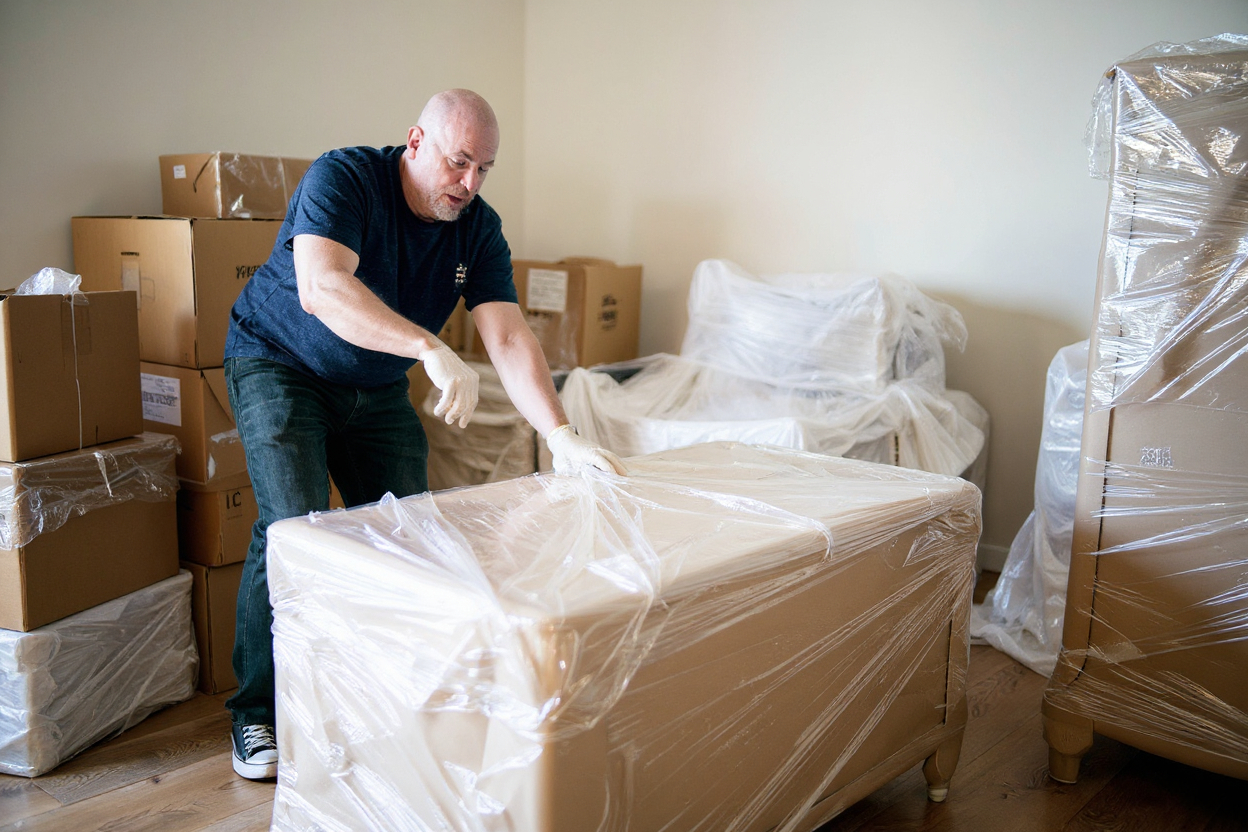
Picture yourself for a moment as a surgeon preparing for a highly complex operation. Every instrument has to be sterilised, every movement calculated, every contingency anticipated. Now apply that mindset to your most complicated move: the one where you have to relocate your grand piano, your 30-year wine collection, the artwork you inherited from your grandmother and that Murano glass cabinet that’s the envy of all your guests. The difference between success and disaster lies not only in the experience of the moving crew but in something far more fundamental and technical: professional packing.
Professional packing is not simply “putting things in sturdier boxes.” It’s an applied science that combines knowledge of physics, materials chemistry, structural engineering and a deep understanding of how objects react to forces, vibrations, temperature changes and pressure during transport. When your move is classed as “complex” — whether because of fragile items, the distance involved, access conditions or a combination of all these factors — packing stops being optional and becomes the difference between keeping your treasures intact and facing irreparable losses.
The science behind specialised packing
Professional packing is built on scientific principles that go well beyond intuition. Every material is chosen specifically for its physical properties: compression resistance, impact absorption, thermal stability and chemical compatibility with the items it protects. Packing professionals understand concepts such as load distribution, stress points and resonance frequencies, which can be devastating for fragile objects.
The physics of impact is particularly relevant in complex moves. During transport, your items are exposed to three main types of force: constant low-frequency vibration from the engine and the road, sudden impacts from braking or potholes, and compression forces from the weight of other objects. Professional packing creates cushioning systems that absorb these forces before they reach the protected object, using materials with different elasticity coefficients positioned strategically.
Temperature and humidity changes add another layer of complexity. Materials expand and contract at different rates, which can create devastating internal stresses in complex objects. Professional packing includes vapour barriers, thermally stable materials and sometimes even passive climate-control systems that maintain stable conditions regardless of external variations.
Advanced materials: beyond traditional cardboard
The materials used in professional packing represent decades of research and development in materials science. Polyurethane foams of specific densities, bubble wrap with different air-chamber sizes, phase-change materials that absorb heat, and anti-static barriers that protect electronic equipment are just a few examples of the technical sophistication involved.
Internal suspension systems allow extremely fragile objects to “float” inside their containers, completely isolated from any external impact. These systems use networks of tensioned cables, viscoelastic gel supports or even pneumatic systems that adjust automatically to transport conditions. For one-of-a-kind items, such as precision scientific instruments or irreplaceable works of art, fully bespoke packing systems are designed.
Stress testing is fundamental to developing these systems. Professional packing is subjected to drop, vibration, compression and thermal-cycle tests that simulate the most extreme conditions it may encounter in transit. Only systems that pass these rigorous standards are considered suitable for complex moves where the margin for error is zero.
Art and antiques: special cases that demand expertise
Artworks and antiques present unique challenges that go beyond their monetary value. Each piece has specific characteristics: oils on canvas can crack with vibrations at certain frequencies, bronze sculptures can develop corrosion if exposed to moisture, and antique furniture can come apart if the wood expands or contracts due to climate changes.
Packing artworks requires specialised conservation knowledge. The materials used must be chemically inert to avoid reactions that could damage pigments or varnishes. Support systems must distribute weight evenly to prevent warping, and ventilation must be controlled to prevent condensation without exposing the piece to atmospheric contaminants.
Antiques often combine multiple materials with different coefficients of thermal expansion. An 18th-century pendulum clock may have bronze, steel, wood and glass components, each reacting differently to environmental changes. Professional packing must anticipate these reactions and create stable microclimates that preserve the structural integrity of these complex objects.
Musical instruments: the complexity of resonance and tension
Musical instruments are among the most complex challenges in professional packing. A piano is not simply a heavy piece of furniture; it’s an extremely delicate tension system in which thousands of kilograms of force are distributed across strings, pins and a wooden frame that has been meticulously adjusted over decades. Any change in that tension can cause permanent damage affecting both the functionality and the value of the instrument.
String instruments are particularly sensitive to vibration. Specific frequencies can create resonances that amplify destructive forces, potentially causing strings to break or the internal structure to shift out of alignment. Professional packing uses materials that selectively absorb these problematic frequencies while allowing the instrument to “breathe” to prevent dimensional changes from humidity.
Wind instruments present different but equally complex challenges. Metals can deform with temperature changes, keys can go out of alignment with vibration, and valve systems can be affected by microscopic particles that work their way in during transport. Packing must create fully controlled environments that keep these instruments in concert-hall condition throughout the entire move.
Sensitive technology: protecting your digital world
In the digital age, many complex moves include tech equipment that goes well beyond the typical laptop. Home servers, professional recording gear, scientific instruments and home-automation systems require specialised protection that goes far beyond conventional packing.
Electronic components are vulnerable to electrostatic discharge, which can cause microscopic damage that only shows up as intermittent faults weeks after the move. Professional packing includes anti-static materials, grounding systems and specific protocols to keep these components safe throughout the entire transport process.
Mechanical hard drives have particular requirements due to the extreme precision of their internal components. Vibrations imperceptible to humans can cause the read heads to contact the storage platters, resulting in data loss. Professional packing uses vibration-isolation systems that keep these devices completely stable regardless of transport conditions.
Liquids and special substances: when the contents define the container
Complex moves often include valuable liquids such as collectible wines, artisan oils, medicines or even chemicals for specialised hobbies. Each type of liquid presents unique challenges that call for specific packing and transport approaches.
Wine is a particularly complex case because it’s sensitive to both vibration and temperature changes. Vibrations can disturb natural sediment, affecting flavour and the ageing process. Temperature changes can alter the internal pressure of bottles, potentially pushing corks in or out. Professional wine packing includes passive climate-control systems and vibration isolation calibrated specifically to protect these delicate liquids.
Chemicals require knowledge of material compatibility to avoid dangerous reactions. Some acids can corrode certain types of foam, some solvents can dissolve specific plastics, and some bases can react with seemingly inert materials. Professional packing requires detailed chemistry knowledge to select materials that are fully compatible with the substances being transported.
Documents and irreplaceable keepsakes
Historical documents, family photographs and sentimental items pose a unique challenge: their value can’t be measured in money, yet their loss would be irreplaceable. These objects require protection that goes beyond physical resistance, including protection against environmental factors that can cause gradual but irreversible degradation.
Paper documents are particularly vulnerable to humidity, which can cause fibres to swell and contract, resulting in rippling, staining or even the separation of inks from the paper. Professional packing uses archival materials that maintain stable humidity levels and provide barriers against atmospheric contaminants that can accelerate ageing.
Photographs have additional characteristics because the chemicals used in their processing can react with unsuitable packing materials. Old photo albums often use adhesives that have turned acidic over time, and exposure to certain materials can accelerate degradation. Professional packing uses pH-neutral materials and chemical barriers that protect against these adverse reactions.
Integrated systems and complex installations
Modern moves often include integrated systems that must be dismantled, transported and reinstalled while retaining their original functionality. Home-automation systems, high-end audio installations, professional gym equipment and specialised workshops require packing approaches that consider not only protection in transit but also ease of reinstallation.
The cables and electronic components of these systems require meticulous labelling and specific protection. Connections can be extremely sensitive to corrosion, cables may have specific minimum-bend requirements, and some components may need recalibration after reinstallation. Professional packing includes documentation systems that ensure every component can be identified and reinstalled correctly.
Heavy equipment with precision components, such as workshop machinery or professional exercise gear, requires partial disassembly for transport. Packing must protect both the individual components and keep organised all the fixings, calibration elements and connections needed for reassembly. Losing a single specialised screw can render thousands of euros’ worth of equipment unusable.
The psychological side: peace of mind as added value
Beyond the technical benefits, professional packing delivers immeasurable psychological value: the peace of mind of knowing that your most prized possessions are protected by systems designed specifically for their unique needs. That peace of mind lets you focus on other critical aspects of your complex move without constant anxiety over the safety of your belongings.
The detailed documentation that comes with professional packing provides complete traceability. Photographs of the packing process, detailed inventories and unpacking protocols let you verify the condition of every object and understand exactly how it was protected. This transparency is especially valuable for high-value items where insurance companies require detailed documentation.
Knowing that professionals such as those at Mudanzas Trallero, with years of experience, have assessed each of your objects and designed specific protection for their unique characteristics removes the uncertainty that can dominate complex moves. That confidence lets you make more rational decisions about other aspects of your move without constantly worrying about possible damage.
The investment in professional packing: a return on protection
The cost of professional packing should be weighed against the total value of the items protected and the potential cost of replacing or repairing them. For complex moves involving one-of-a-kind or high-value items, professional packing isn’t an expense; it’s an investment in preserving fundamental, irreplaceable assets.
The cost-benefit analysis becomes even more favourable once you consider the hidden costs of damage. Restoring antiques can cost many times the object’s original value. Damaged musical instruments can require months of specialised work to restore their original functionality. Tech equipment can suffer damage that doesn’t appear immediately but significantly shortens its lifespan.
Professional packing can also reduce insurance costs for complex moves. Insurance companies recognise that professionally packed items are less likely to suffer damage, and they often offer reduced premiums or broader cover for moves that use these specialised services.
Professional experience makes the decisive difference
Complex moves require more than general sector experience; they demand specific expertise in packing unique objects, knowledge of specialised materials and the ability to design bespoke solutions for unique challenges. The difference between a successful move and a traumatic experience often comes down to the quality and sophistication of the professional packing used.
Mudanzas Trallero combines more than a century of experience in the sector with ongoing investment in the most advanced technologies and materials for specialised packing. Their team of professionals is trained in the most sophisticated protection techniques for unique objects, from artworks to precision instruments, from family antiques to cutting-edge technology. With access to specific packing materials and techniques developed for the world’s most demanding moves, they offer the protection your most valuable possessions deserve. When your move is classed as complex, you can’t afford to compromise on protecting what you value most. Discover how professional packing can ensure your treasures arrive at their destination in perfect condition with Mudanzas Trallero, and trust the specialists who understand that some objects are simply priceless.




